Oracle. The impact of a commit on task execution time.

Many probably know that frequent commits are bad and slow, but how bad and how slow is not clear, and this small test is designed to demonstrate the impact of this event.

I’ll note right away that commits should be made exactly when the business process requires it, or when there is any other significant reason, rather than just ‘in case.’

Test environment:

Oracle 19.23

OS: OEL 8.5 4.18.0-513.24.1.el8_9.x86_64

RAM: 128GB

CPU: AMD Threadripper 1920x

Disks:

Disk group for data files: +ORADATA: SATA SSD GeIL R3 512GB

Disk group for redo logs: +ADATAD1: XPG GAMMIX S11 Pro PCI E 3.0 x4

Disk group for archive logs: +ARCHLOG: SATA SSD GeIL R3 512GB

+ORADATA and +ARCHLOG are located on the same physical disk SATA SSD GeIL R3 512GB.

The code that will act as the load (intensive business process activity):

Variant 1:

declare
v_loop number;
v_seq number;
v_text varchar2(3000);
v_rtext varchar2(3000);
begin
  execute immediate 'truncate table t1';
  dbms_output.put_line('Start: '||to_char(sysdate,'dd.mm.yyyy hh24:mi:ss'));
  dbms_workload_repository.create_snapshot;
  v_loop:=1;
  select dbms_random.string(opt => 'X',len => 3000) into v_rtext from dual;
  while v_loop<5000001
    loop
      v_seq:=t1_seq.nextval;
      insert into t1(id,text) values(v_seq,v_rtext);
      commit write wait;
      select t1.text into v_text from t1 where id=v_seq;
      update t1 set t1.text='update' where id=v_seq;
      commit write wait;
      delete from t1 where id=v_seq;
      commit write wait;
      v_loop:=v_loop+1;
      end loop;
      dbms_workload_repository.create_snapshot;
      dbms_output.put_line('End: '||to_char(sysdate,'dd.mm.yyyy hh24:mi:ss'));
   end;

Variant 2:

declare
v_loop number;
v_seq number;
v_text varchar2(3000);
v_rtext varchar2(3000);
begin
  execute immediate 'truncate table t1';
  dbms_output.put_line('Start: '||to_char(sysdate,'dd.mm.yyyy hh24:mi:ss'));
  dbms_workload_repository.create_snapshot;
  v_loop:=1;
  select dbms_random.string(opt => 'X',len => 3000) into v_rtext from dual;
  while v_loop<5000001
    loop
      v_seq:=t1_seq.nextval;
      insert into t1(id,text) values(v_seq,v_rtext);
      select t1.text into v_text from t1 where id=v_seq;
      update t1 set t1.text='update' where id=v_seq;
      delete from t1 where id=v_seq;
      commit write wait;
      v_loop:=v_loop+1;
      end loop;
      dbms_workload_repository.create_snapshot;
      dbms_output.put_line('End: '||to_char(sysdate,'dd.mm.yyyy hh24:mi:ss'));
   end;

The difference between the first and second options is that the first option has 3 commits within the loop, while the second has 1 commit within the loop. Also, the ‘commit write wait’ construct is chosen to avoid PL/SQL optimization, as this commit variant is used if the code is not written in PL/SQL.

Variant 1 took 23 minutes and 6 seconds (1386 seconds) to complete.

Variant 2 took 12 minutes and 51 seconds (771 seconds) to complete.

Variant 3 (commit executed only at the end of the loop) took 503 seconds, but it’s not considered for evaluation.

So, Variant 2 is nearly twice as fast.

Reasons why Variant 1 took longer:

Further calculations are done with a certain margin of error, and it is assumed that all statistics relate only to the tasks being performed.
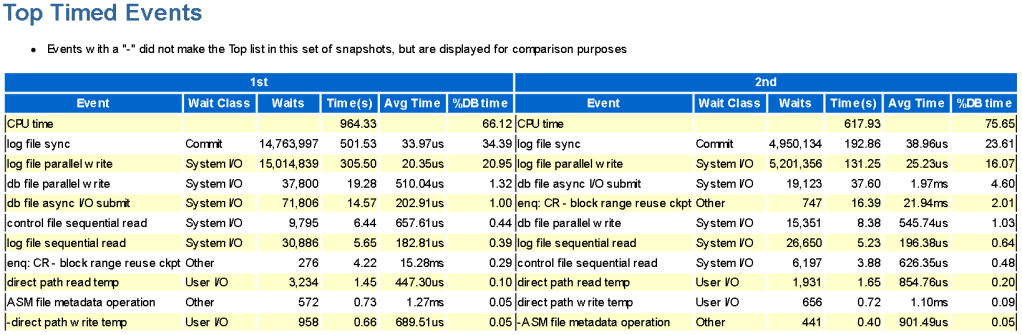
Variant 1 took 501 seconds for log file sync (lfs) out of 1386 seconds, while variant 2 took 192 seconds for log file sync (lfs) out of 771 seconds. By subtracting 501 from 1386, we get 885 seconds. Mathematically excluding all intermediate commits in the loop from variant 1, it still takes more time than variant 2, with 885 seconds versus 771 seconds.

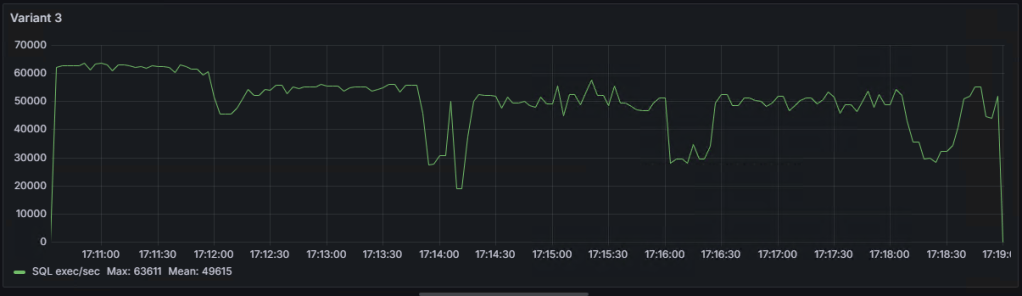
Graph of the number of SQL statement executions per second for ‘Variant 1,’ ‘Variant 2,’ and ‘Variant 3’:

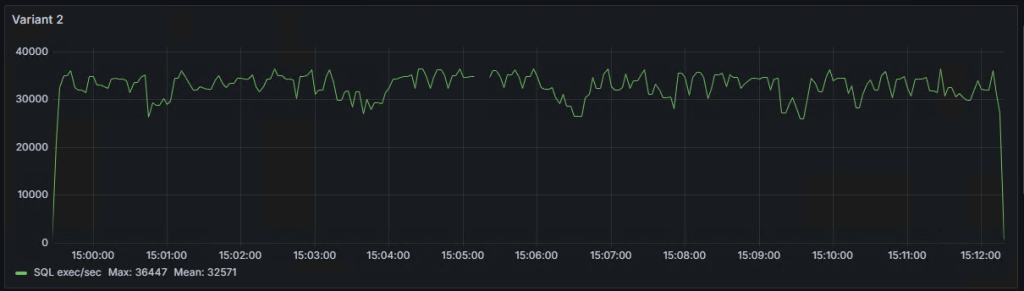
As seen on the graphs, there are some ‘dips,’ the explanations for which I will try to provide in the following note.

AWR reports for ‘Variant 1,’ ‘Variant 2,’ ‘Variant 3,’ and AWR comparison between ‘Variant 1’ vs ‘Variant 2’.

Oracle. Влияние коммита на время выполнения задачи.

Многие наверно знают, что частые коммиты — это плохо и медленно, но насколько плохо и насколько медленно, не понятно и данный маленький тест призван показать влияние этого события.

Сразу отмечу, что выполнять коммит нужно ровно тогда, когда этого требует бизнес-процесс, либо имеется любая другая веская причина, а не просто “на всякий случай”.

Тестовый стенд:

Oracle 19.23

OS: OEL 8.5 4.18.0-513.24.1.el8_9.x86_64

RAM: 128GB

CPU: AMD Threadripper 1920x

Диски:

Дисковая группа для датафайлов: +ORADATA: SATA SSD GeIL R3 512GB

Дисковая группа для редологов:    +ADATAD1: XPG GAMMIX S11 Pro PCI E 3.0 х4

Дисковая группа для архивных логов: +ARCHLOG: SATA SSD GeIL R3 512GB

+ORADATA и +ARCHLOG расположены на одном физическом диске SATA SSD GeIL R3 512GB.

Код, который будет выступать в виде нагрузки (бурной деятельности бизнес-процессов):

Вариант номер 1:

declare
v_loop number;
v_seq number;
v_text varchar2(3000);
v_rtext varchar2(3000);
begin
  execute immediate 'truncate table t1';
  dbms_output.put_line('Start: '||to_char(sysdate,'dd.mm.yyyy hh24:mi:ss'));
  dbms_workload_repository.create_snapshot;
  v_loop:=1;
  select dbms_random.string(opt => 'X',len => 3000) into v_rtext from dual;
  while v_loop<5000001
    loop
      v_seq:=t1_seq.nextval;
      insert into t1(id,text) values(v_seq,v_rtext);
      commit write wait;
      select t1.text into v_text from t1 where id=v_seq;
      update t1 set t1.text='update' where id=v_seq;
      commit write wait;
      delete from t1 where id=v_seq;
      commit write wait;
      v_loop:=v_loop+1;
      end loop;
      dbms_workload_repository.create_snapshot;
      dbms_output.put_line('End: '||to_char(sysdate,'dd.mm.yyyy hh24:mi:ss'));
   end;

Вариант номер 2:

declare
v_loop number;
v_seq number;
v_text varchar2(3000);
v_rtext varchar2(3000);
begin
  execute immediate 'truncate table t1';
  dbms_output.put_line('Start: '||to_char(sysdate,'dd.mm.yyyy hh24:mi:ss'));
  dbms_workload_repository.create_snapshot;
  v_loop:=1;
  select dbms_random.string(opt => 'X',len => 3000) into v_rtext from dual;
  while v_loop<5000001
    loop
      v_seq:=t1_seq.nextval;
      insert into t1(id,text) values(v_seq,v_rtext);
      select t1.text into v_text from t1 where id=v_seq;
      update t1 set t1.text='update' where id=v_seq;
      delete from t1 where id=v_seq;
      commit write wait;
      v_loop:=v_loop+1;
      end loop;
      dbms_workload_repository.create_snapshot;
      dbms_output.put_line('End: '||to_char(sysdate,'dd.mm.yyyy hh24:mi:ss'));
   end;

Отличие первого и второго варианта в том, что первый вариант имеет 3 коммита в цикле, а второй 1 коммит в цикле. Также, конструкция commit write wait выбрана для того, чтобы избежать оптимизации PL/SQL, т.к. данный вариант коммита применяется если код написан не на PL/SQL.

Вариант 1, выполнился за 23 минуты и 6 секунд(1386 секунд)

Вариант 2, выполнился за 12 минут и 51 секунду(771 секунд).

В не зачёта: Вариант 3(коммит выполняется только по окончанию цикла), выполнился за 503 секунды.

Т.е. вариант 2 быстрее почти в 2 раза.

На что вариант 1 потратил время(почему он медленнее):

Далее расчеты делаются с определённой погрешностью и предполагается, что все статистики относятся только к выполняемым задачам.

Вариант 1 из 1386 секунд, потратил на log file sync(lfs) 501 сек, а вариант 2 из 771 секунд, потратил на log file sync(lfs) 192 сек. Отняв от 1386, 501, получим 885 сек, т.е. математически исключим все промежуточные коммиты в цикле из варианта 1, всё равно вариант 1  затрачивает времени больше, чем вариант 2, 885сек против 771сек.

График количества выполнений SQL выражений в секунду для “вариант 1”,“вариант 2” и “вариант 3”:


Как видно на графиках, есть некие “провалы”, объяснения которым я попробую дать в следующей заметке.

AWR отчеты для “вариант 1”, “вариант 2”, “вариант 3” и AWR сравнение “вариант 1” vs “вариант 2”: